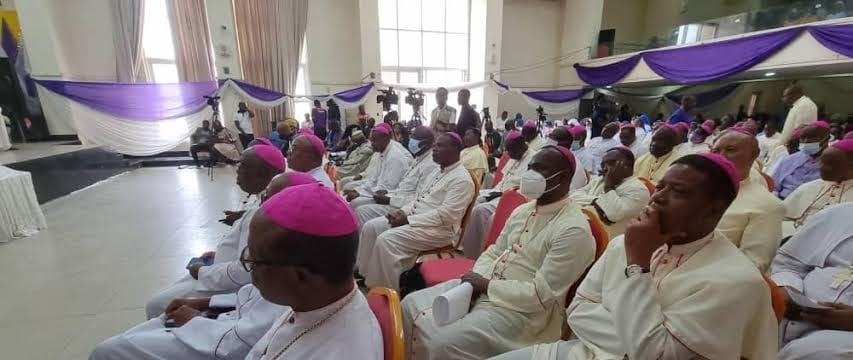
The Catholic Bishops Conference of Nigeria (CBCN) has called on the Federal Government to intensify efforts to tackle insecurity, poverty, poor infrastructure and other challenges confronting Nigerians.
The bishops made the demand in a communiqué issued at the end of their Second Plenary Meeting for 2026, held at the Our Lady and St. Kizito Pastoral Centre, Oke-Gada, Ede, in Osun State, from September 10 to 18.
The communiqué was signed by the CBCN President, Archbishop Matthew Man-Oso Ndagoso of Kaduna, and the Secretary, Bishop Peter Olukayode Odetoyinbo of Abeokuta Diocese.
The bishops expressed concern over the persistence of insecurity, kidnapping, banditry, illegal mining, poverty, poor infrastructure and what they described as assaults on human dignity across the country.
Bishops Demand Stronger Action Against BanditryOn insecurity, the CBCN acknowledged the government’s move towards decentralising the police system, but urged that any reorganisation should serve the common good rather than personal, ethnic, political or religious interests.
The bishops said kidnapping, banditry, illegal mining and the theft of the country’s natural resources continued to deprive citizens of peace and threaten national unity.
They particularly urged the government to take decisive steps to end banditry, recover large portions of land occupied by criminal groups and return such areas to productive use.
The bishops also expressed concern over the continued invasion of schools and places of worship, as well as the abduction and killing of students and worshippers.
They called for stronger security forces, improved intelligence gathering and accountability for those responsible for acts of violence.
The CBCN further urged the government to intensify efforts to enable millions of internally displaced persons to return to their ancestral communities.It also called for migrants and refugees to be treated with respect and have their basic rights protected.
Catholic Bishops Raise Alarm Over Poverty
The bishops expressed concern about the level of poverty and economic hardship in Nigeria, saying many families were struggling to meet basic needs despite the country’s abundant resources.
They called on federal and state governments to create more employment opportunities, support local businesses and formulate economic policies capable of reducing the financial burden on poor Nigerians.
The CBCN also urged the government to create an enabling environment for greater private-sector participation in the economy.At the same time, the bishops encouraged Nigerians to engage in honest labour, support local businesses and shun criminality and corruption.
Bishops Demand Better Roads, Electricity, Railways
The bishops also criticised the state of infrastructure across the country, citing bad roads, erratic electricity supply and failing public utilities as obstacles to economic growth and daily life.They urged governments to increase transparent investment in public infrastructure, repair critical roads and provide reliable electricity and clean water.
The CBCN specifically called for the expansion of railway transport facilities across the country to improve socioeconomic activities.CBCN Rejects Foreign Aid Regulation BillThe Catholic bishops also called on the National Assembly and Federal Government to halt the process of turning the Foreign Aids (Regulation, Transparency and Disclosure) Bill 2026 into law.
According to the CBCN, although some provisions of the bill appear designed to regulate foreign aid, they could negatively affect churches, mosques, schools and humanitarian organisations providing assistance to vulnerable and conflict-affected communities.
The bishops expressed concern over provisions that could allow authorities to deny registration or refuse renewal where an organisation’s activities are considered not to be in the “national interest.”They argued that such provisions could give government officials excessive discretionary powers and create additional bureaucracy.
The CBCN noted that non-profit organisations, incorporated trustees, religious bodies and humanitarian groups are already regulated by the Corporate Affairs Commission under the Companies and Allied Matters Act and other existing laws.
The bishops therefore urged the National Assembly and Federal Government to reconsider the bill, citing the need to protect freedom of association, religion, thought and conscience.
Bishops Warn Politicians Over AI Ahead of 2027 Elections
On technology and artificial intelligence, the CBCN urged politicians and other stakeholders to exercise responsibility and uphold ethical standards in the deployment of emerging technologies.
The bishops said technology should be used to transform data into knowledge and insights that benefit humanity, particularly as Nigeria approaches the 2027 general elections.
They stressed that technology should remain subject to human values and ethical considerations.
CBCN Calls for Credible 2027 Elections
The bishops called on all stakeholders to work towards free, fair and credible elections in 2027.They encouraged eligible Nigerians to participate actively in the electoral process and vote for qualified candidates in accordance with their consciences.
The CBCN disclosed that it had issued a pastoral letter on the forthcoming elections and urged citizens to study and follow its provisions and guidelines.
It also directed dioceses and parishes across the country to organise civic education and voter mobilisation activities, alongside end-of-month fasting and Rosary processions from October to December 2026.
The bishops announced December 8, 2026, as a special national day of prayer and fasting for the success of the 2027 elections.
Bishops Speak on Human Dignity, AbuseThe CBCN reaffirmed the dignity of every human person, describing it as the foundation of human rights, social justice and the common good.
The bishops condemned sexual and other forms of violence and abuse, stressing that such acts violate human dignity and inflict lasting wounds on victims.
They urged Catholics and the wider society to reject all forms of violence and abuse and to promote relationships based on love, fidelity and mutual respect.
The bishops also acknowledged that the Church’s credibility is affected by how it responds to abuse, protects vulnerable people and listens to victims.
Church Raises Concern Over Neo-PaganismThe CBCN also expressed concern over what it described as the continued spread of neo-paganism in Nigeria, particularly among young people.
The bishops linked the trend to economic hardship, cultural revival and inadequate Christian formation.They urged pastoral workers to make greater use of digital platforms, social media and online catechesis to teach Christian values and engage young people.
The bishops also advocated healthy inculturation that respects positive aspects of Nigerian cultural heritage while upholding fundamental Christian teachings.
Bishops Urge Government to Fund Education
The CBCN described quality education as essential to human development, peaceful coexistence and the integration of Nigeria’s diverse peoples and cultures.
The bishops said the Catholic Church remained willing to collaborate with government in providing quality education.
They, however, urged governments to fulfil their constitutional responsibility to fund education and ensure that children have access to quality education, particularly at the primary and secondary levels.The bishops also called for policies that would promote human development and national progress.
CBCN Congratulates Archbishop Martins, Mourns BishopsThe conference congratulated its Vice President, Archbishop Alfred Adewale Martins of Lagos Archdiocese, on his appointment to the Dicastery for Evangelization, Section for First Evangelization and the New Particular Churches.
The bishops also commiserated with Abakaliki Diocese following the death of Bishop Peter Nworie Chukwu on April 10, 2026, and the Archdiocese of Benin City over the death of Archbishop Augustine Obiora Akubeze on July 9, 2026.
They congratulated Most Rev. Ernest Obodo and Most Rev. Donatus Ogun on their appointments as Apostolic Administrators of Abakaliki Diocese and Benin City Archdiocese respectively.
The bishops concluded by calling for a renewed politics focused on moral principles, human dignity, protection of human life and the pursuit of the common good.
They also urged Nigerians to remain hopeful and contribute positively to national development while continuing to pray for those holding political offices.