
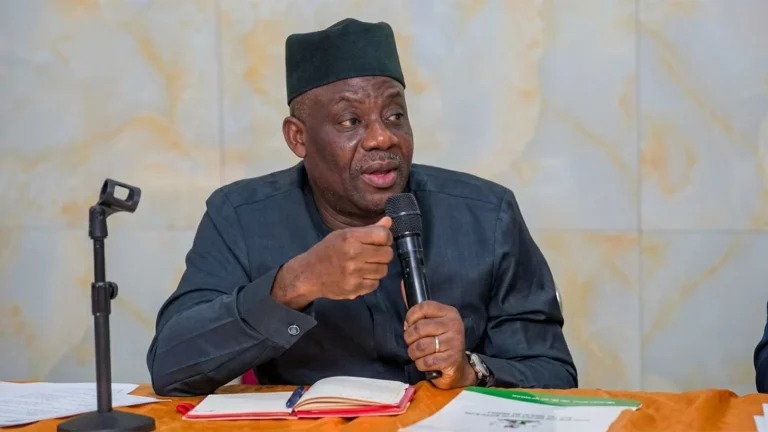
The Federal Government has commenced plans to overhaul the accreditation system for tertiary institutions in Nigeria, with the Minister of Education, Dr Tunji Alausa, warning universities, polytechnics and colleges of education against presenting borrowed staff, equipment and facilities during accreditation exercises.
Alausa said the government was working to transform the existing accreditation system from a periodic exercise into a continuous, digital and data-driven quality assurance process capable of accurately verifying the actual capacity of tertiary institutions.
The minister spoke on Wednesday during the inauguration of the Ministerial Committee on Strengthening Accreditation and Quality Assurance Systems for Tertiary Institutions in Nigeria.
According to him, the current accreditation framework must be strengthened to make it more transparent, efficient, evidence-based and difficult to manipulate.
FG Targets Borrowed Staff, Equipment During AccreditationAlausa warned tertiary institutions against creating a temporary impression of their capacity simply to pass accreditation exercises.
He said some institutions had developed the practice of temporarily moving academic and non-academic staff, equipment, laboratory facilities, workshop resources and library materials from other institutions for presentation to accreditation teams.
“An institution should not be able to prepare a temporary picture of itself simply for the purpose of an accreditation visit. Sadly, this is what persists in the majority of instances,” the minister said.
He stressed that whatever an accreditation team sees and verifies must reflect the actual and sustainable capacity of the institution.
Alausa said the government would also address the temporary movement, borrowing or presentation of equipment and other infrastructure solely for accreditation purposes.
FG Plans Digital Verification of Tertiary Institutions
The minister said technology would play a major role in the proposed accreditation reforms, including the use of geospatial mapping, geotagging and digital identification technologies to verify institutional infrastructure, equipment and personnel.
According to him, critical equipment presented during accreditation should be digitally identifiable and linked to the institution and physical location where it is actually deployed.
Such equipment, he said, should have a unique digital record containing information such as its location, status and other relevant details.
On staffing, Alausa called for a comprehensive digital identity management and staff verification framework that would enable regulators to establish the identity, presence and institutional affiliation of personnel presented by tertiary institutions.
He said the proposed system should leverage national identity infrastructure and interoperable government databases while complying with existing data protection laws.
Education Ministry Proposes NIN-Based Staff Verification
Alausa also proposed collaboration with the National Identity Management Commission (NIMC) to use the National Identification Number (NIN) alongside BVN infrastructure and other secure technologies.
The objective, he explained, is to establish the principle of “one individual, one verifiable identity and an accurately declared institutional affiliation.”
The system would also help regulators identify cases where an individual is improperly presented as full-time academic or non-academic personnel in multiple institutions.
FG Wants Continuous Accreditation System
The minister said the reforms were necessary because the current accreditation model largely operates as a periodic exercise conducted every three to five years.
He argued that tertiary institutions should maintain required standards throughout the year instead of making special preparations whenever accreditation teams are scheduled to visit.
“A longer-term objective should be to move from accreditation as an event to accreditation as a continuous quality assurance process,” Alausa said.
Under the proposed digital framework, regulators would continuously maintain and periodically verify information relating to staffing, infrastructure, laboratories, workshops, libraries and equipment before physical accreditation visits.
Alausa said physical inspections would remain important but should increasingly serve as a means of validating verified digital data rather than starting the verification process from scratch.The proposed reforms are expected to strengthen quality assurance in Nigerian tertiary institutions, improve transparency in accreditation and make it more difficult for institutions to conceal gaps in staffing, infrastructure and learning facilities.