Ekiti State Governor, Biodun Oyebanji, has disclosed that his administration generated ₦88.4bn in internally generated revenue (IGR) over four years, alongside major investments in infrastructure, education, healthcare and agriculture.
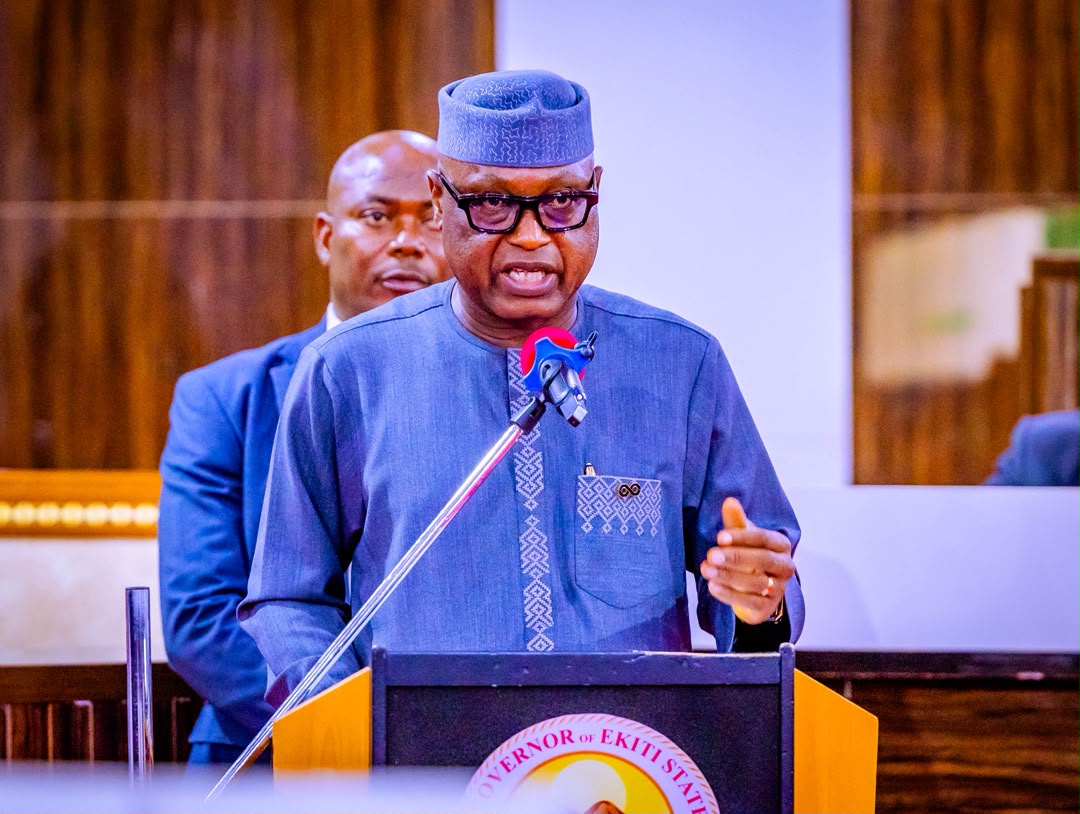
Oyebanji stated this on Tuesday while delivering his four-year stewardship address at the Ekiti State House of Assembly Complex, Ado-Ekiti, ahead of his second-term inauguration on Friday, October 16, 2026.
The governor said monthly IGR had increased from between ₦650m and ₦700m when he assumed office in 2022 to an average of ₦2.6bn in 2026.
He added that the state’s GDP had grown from ₦2.4tn in 2019 to ₦4.6tn in 2023, with recent projections approaching ₦8.8tn.On infrastructure, Oyebanji said his administration had constructed 425.049 kilometres of roads, while additional urban and rural road projects were ongoing.
He also disclosed that work was progressing on the Ekiti Agro-Allied International Cargo Airport, with the installation of an Instrument Landing System and plans for improved runway lighting.
In the security sector, he highlighted the establishment of the Agro-Marshal Corps, improved intelligence gathering and the distribution of 100 patrol vehicles to security agencies.
He also acknowledged the contributions of the Nigerian Army, Amotekun and other security organisations to maintaining peace in the state.
The governor said his administration had employed 6,530 teachers and 1,900 health workers.
He added that 177 primary healthcare centres had undergone the first phase of revitalisation, while 12 general hospitals had been renovated and equipped.
On education, Oyebanji highlighted government-funded external examinations, scholarships and bursaries for students.
He also disclosed that the College of Health, Science and Technology, Ijero-Ekiti, had been upgraded to polytechnic status.
He said the Ulerawa healthcare initiative had expanded access to free essential medical services, including maternal and child healthcare, malaria treatment and family planning.
He also cited improvements in child health indicators, including a reported increase in fully vaccinated children from 41 per cent to 57 per cent between 2020 and 2025.
In agriculture, the governor said about 5,000 youths were engaged in various agricultural programmes, while more than 10,000 hectares of farmland had been prepared through the subsidised tractorisation scheme.
He also highlighted initiatives to make locally produced food more accessible and affordable.
Oyebanji disclosed that construction had commenced at the Ekiti Knowledge Zone, supported by $80m in funding from the African Development Bank.
He said the project, alongside the State Agricultural Processing Zone, would help attract investment, create jobs and strengthen the state’s industrial base.
On workers’ welfare, the governor reported paying more than ₦36.6bn in pensions to state retirees and ₦11.7bn in gratuities to beneficiaries since assuming office.
He also highlighted support for local government retirees, public servants and workers seeking career advancement.
The administration, he added, had implemented programmes supporting women, persons with disabilities and other vulnerable groups through vocational training, financial assistance, scholarships and the provision of assistive devices.
Oyebanji also cited Ekiti’s performance in fiscal transparency assessments, including first-place rankings in several quarters of BudgIT’s State Fiscal Transparency League in 2024 and 2025.
Looking ahead, the governor said his second term would prioritise agricultural industrialisation, the knowledge economy, infrastructure and investment-driven job creation.
He thanked President Bola Tinubu, the State Assembly, traditional rulers, public servants and residents for their support, pledging to sustain efforts towards economic prosperity and improved living standards.